
Guatemala: Adding Depth to America’s Supply Chains
By Juan Esteban Sánchez, Executive Director, Invest Guatemala
In 2025, U.S. imports from China fell by roughly $130 billion, and other suppliers filled about two-thirds of the gap, according to the McKinsey Global Institute. Yet replacing Chinese imports with production concentrated in a few countries does not create resilience. The next stage of supply chains should build depth, meaning more suppliers, more production locations and more logistics routes within a trusted economic space. Guatemala can contribute to that stage, and the reason begins with Mexico.
Mexico shows both the reach and the limits of regional integration. The United States imported $534 billion in goods from Mexico in 2025, and 88 percent of imports from Mexico in early 2026 entered as USMCA-compliant. That success has produced concentration, since Mexico supplies roughly 69 percent of U.S. wiring-harness imports. Energy capacity is tightening too, as Mexico’s plan to expand transmission by about 6 percent over five years lags demand growth, and developers expect delays of at least three years for new connections, S&P Global reports. Supplier networks show gaps as well, since 16 anchor auto-parts firms in an IFC pilot identified 35 supply requirements they could not meet locally, including steel stampings imported from Türkiye.
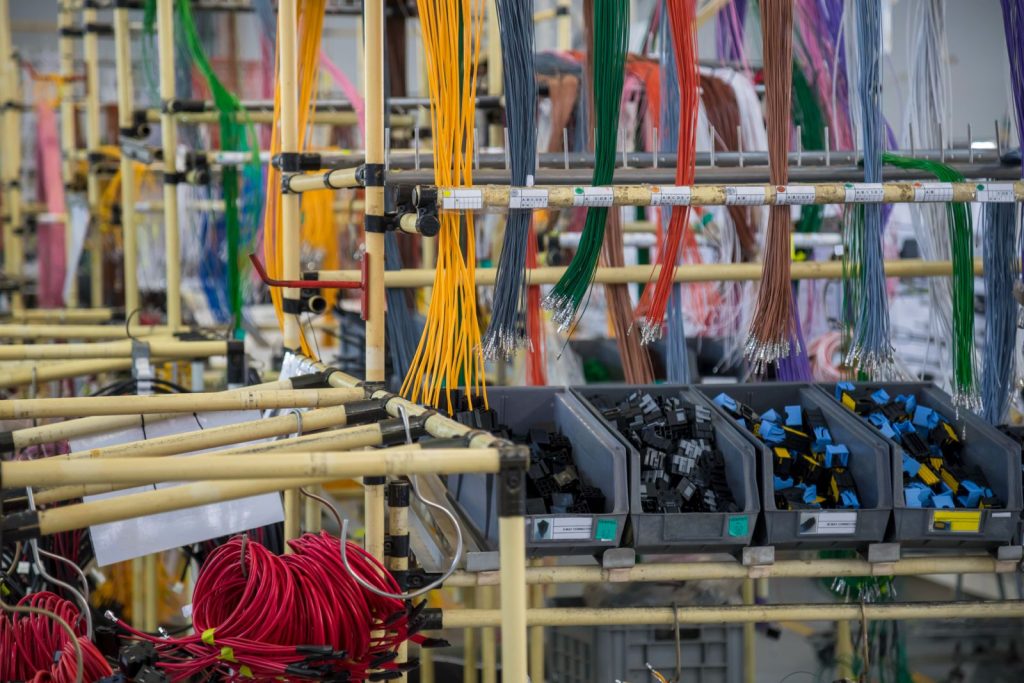
These gaps sit in industries where production can be split across borders. Wire harnesses, apparel, packaging and processed foods are modular, labor-intensive and moderately energy-intensive, so they need reliable suppliers near final assembly rather than co-location. Guatemala meets that condition, since it borders Mexico, has ports on both oceans and holds trade agreements with the United States and Mexico.
The model already works. Guatemalan apparel incorporates U.S. and regional yarn and fabric under CAFTA-DR’s yarn-forward rule. Harness exports grew from zero to about $40 million in seven years, joining a Central American cluster that ships roughly $1.8 billion a year to the United States. Plastics converters turn U.S. resin into packaging and into tableware, where China still supplies 79 percent of U.S. imports. Trade with Mexico, however, runs mostly one way. In 2023 Guatemala bought $3.4 billion from Mexico and sold it $673 million, so the country is already part of Mexico’s market but not yet of its supply base.
Closing that gap depends on trade rules more than geography. USMCA requires 75 percent North American content for autos, so a harness assembled in Guatemala counts as non-originating even if it embeds U.S. copper. The three agreements operate separately, linked only by a narrow textile provision that lets Central American woven apparel use Mexican yarn and fabric up to 100 million square meters a year. Extending cumulation to selected industrial chapters would let Guatemalan sub-assemblies count toward North American content and Mexican inputs toward CAFTA-DR origin. Digital traceability would keep transshipped Asian goods out. The January 2026 Agreement on Reciprocal Trade, with its commitments on supply-chain resilience, export controls and investment security, already provides the legal basis for that safeguard.
Integration of this kind requires long-horizon investment, which Guatemala’s macroeconomic foundations support. Public debt is near 27 percent of GDP, reserves stand at $27.1 billion and the sovereign rating is one notch below investment grade, according to the IMF. The gaps are equally measurable. Only $204 million of Guatemala’s $1.88 billion in 2025 FDI went to manufacturing, and its logistics performance ranks 88th in the World Bank’s index, against Mexico’s 66th. Electricity is not cheaper than in Mexico, so the advantage must come from capacity, which a 1,400 MW tender for new firm generation by 2030 aims to secure.
Geography adds a second, logistical contribution. In fiscal 2024, Panama Canal transits fell 21 percent as drought forced water-saving measures. A road-and-rail corridor between Puerto Quetzal on the Pacific and Santo Tomás de Castilla on the Atlantic would not replace the canal but would offer a second route when it is constrained. Puerto Quetzal’s expansion is being designed with the U.S. Army Corps of Engineers, and an August 2026 port law created an autonomous national port authority. DFC, EXIM and USTDA participation would build that redundancy to U.S. standards.
Reaching scale will depend on three conditions. Guatemala must execute its public-private partnership pipeline, accelerate permitting and customs clearance, and work with its partners toward rules of origin that treat Mexico, Central America and the United States as one production space.
Nearshoring has often been measured by distance, but the better measure is depth. Guatemala’s opportunity is not simply proximity to the United States but a place in what it produces, sources and secures within the hemisphere, adding depth behind Mexico and an alternative route beside Panama.
The U.S.–Guatemala Business Council invites industry leaders from both countries to deepen this conversation. As Guatemala and the United States advance the priorities of the Agreement on Reciprocal Trade, the Council will continue to convene manufacturers, investors, logistics providers and public-sector counterparts to identify the most concrete opportunities in the shared economic agenda, from supply chain integration to infrastructure and investment.
About the author:
Juan Esteban Sanchez: Executive Director of Invest Guatemala. An economist holding an MBA and a Master’s degree in Real Estate Project Management and Evaluation, with experience in investment banking and FDI promotion.
Sources and further reading
- McKinsey Global Institute, Geopolitics and the geometry of global trade: 2026 update, March 2026.
- Office of the U.S. Trade Representative, Guatemala and Mexico country pages, 2025 trade data; Agreement on Reciprocal Trade signing, January 30, 2026.
- S. International Trade Administration, CAFTA-DR textile and apparel provisions and Guatemala energy country guide, March 2026.
- International Finance Corporation, new phase of Mexico’s Supplier Development Program, August 4, 2025.
- S&P Global Commodity Insights, Mexico’s multibillion-dollar transmission push falls short, September 2, 2025.
- International Monetary Fund, Guatemala 2025 Article IV concluding statement, June 23, 2025.
- World Bank, Logistics Performance Index 2023.
- Banco de Guatemala, Inversión Extranjera Directa 2025.
- Panama Canal Authority, FY24 financial results, October 25, 2024.
- Congressional Research Service, S.–Mexico Trade Relations (IF11175), August 2026.